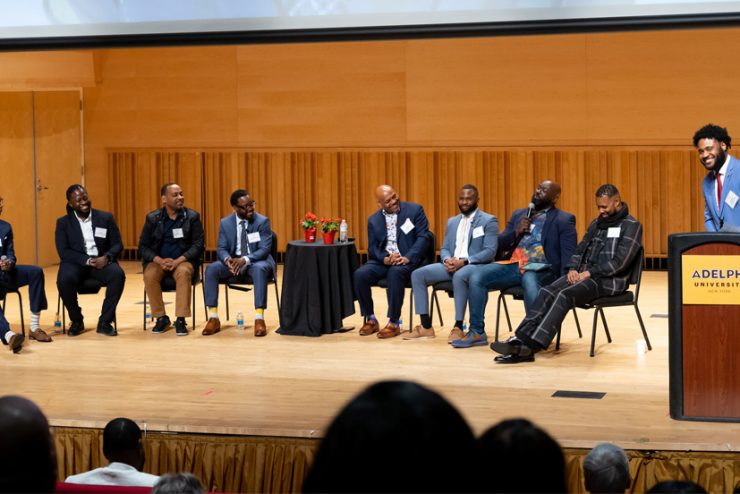
Explore a broad range of majors, minors, and courses in the humanities, arts and STEM fields. You’ll experience a rich, well-rounded education rooted in Adelphi’s strong liberal arts tradition.
Hands On
Did you know active learning is a critical part of an Adelphi education?

Leading in Teaching
Our Arts and Sciences faculty are renowned not just for their research and academic credentials, but also for their leadership in finding new, highly effective and innovative ways to teach.
At Adelphi, the College of Arts and Sciences is the bedrock of our liberal arts education.
We are an extraordinary community of scholars, scientists, and artists who will lead you through an expansive and adventurous curriculum that embodies the very best that a liberal arts education offers. Together, we will commit to the continuum of learning, in which the past comes alive, enabling the future, using the foundations of those who have come before us to generate new knowledge and forge new pathways into our global world.
In the College of Arts and Sciences, you will take classes that will challenge you expand your perspective, and ask the vital question of “why?” You will engage in research – within and beyond the classroom – and be part of a community of learners to bring about the promise of the University’s motto: the truth shall make us free.
Diversity Statement
The College of Arts and Sciences at Adelphi University is a community of educators, learners and creators committed to advancing the values of diversity, equity, inclusion, accessibility, global citizenship and sustainability. These principles enrich our community, promote meaningful relationships, enhance our experiences, allow us to prioritize care for those most vulnerable and improve the long-term well-being of all. This mission drives the College of Arts and Sciences to meaningfully engage and center members of communities that have been historically, institutionally and systemically silenced and oppressed. We further support and champion initiatives, activities, discussions and practices in scholarship, creative work, teaching and service at the University and in the broader community that apply, critique, challenge and improve upon these principles in praxis. We strive to create a more socially just institution, society and world.
Inside Look
Liberal Arts at Adelphi
Sciences at Adelphi
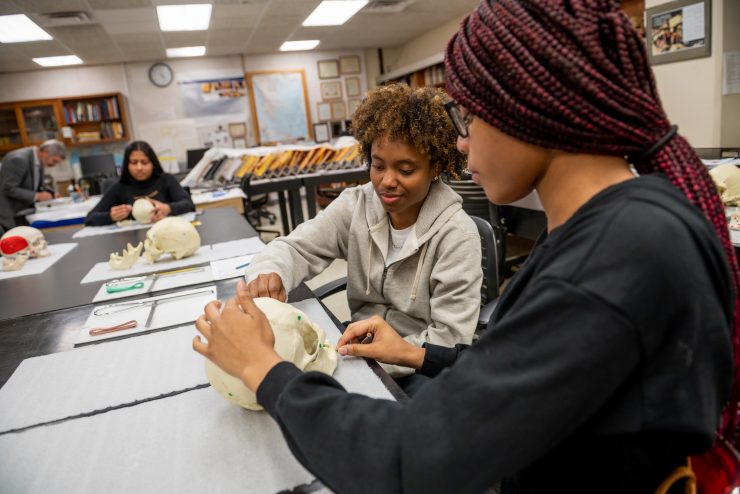
STEM Scholars Program Awards Scholarships to Underserved STEM Students
Adelphi is offering a maximum of $15,000 annual scholarships to 25 high-achieving, Pell Grant-eligible students with demonstrated financial need as a way to give a career boost to high-achieving STEM students. The scholarships are funded by a $2.49 million National Science Foundation grant.